The Truth About Temu Aquarium Equipment: A Survival Guide
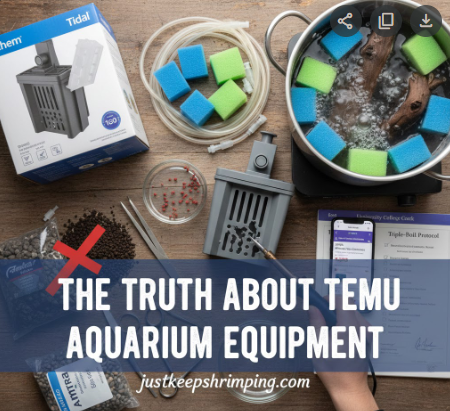
In the world of aquarium keeping, there is a fine line between being a savvy hobbyist and being penny-wise but pound-foolish. As someone with a degree in science, I look at my Neocaridina tanks as delicate biological experiments. Shrimp are essentially the "canaries in the coal mine"—their high surface-area-to-volume ratio and specific genetic makeup make them incredibly sensitive to toxins that wouldn't even make a goldfish flinch.
I am always hunting for the absolute best deals. I hate overpaying for "branded" items that are clearly identical to generic versions. But when you shop on marketplaces like Temu, you aren’t just buying gear; you’re managing risk. Here is my exhaustive breakdown of what to buy, what to avoid, and the "gray areas" in between.
The Good: Non-Mechanical & Simple Materials
For items that are structurally simple, Temu is often a goldmine. Many "boutique" brands on Amazon are simply white-labeling these exact items at a 400% markup.
1. Simple Plastics: "Too Basic to Fail"
As long as the design is simple, it's hard to mess up plastic. I look for items made from Polypropylene (PP) or High-Density Polyethylene (HDPE).
Shrimp Hides & Caves: Simple plastic tubes or mesh "moss ledges" are perfect.
Feeding Rings: A basic plastic square or circle to keep floating food in one place.
The Rule: If it's a solid, unpainted piece of plastic with no moving parts, it's fine. You're just paying for the raw material.
2. Inert Glassware
Glass is the ultimate "safe" material because it is non-porous. I’ve picked up glass feeding tubes and plates for €3–€5. Since chemicals cannot leach into glass, a simple surface clean makes them 100% safe.
3. Bulk Hardware (With a Warning on "Stainless" Steel)
Bulk Accessories: I keep a stockpile of airline tubing, check valves, and airstones. Buying these in bulk for a few Euro ensures I never have to run to the shop for a 50c part.
The Stainless Steel Gamble: While you can find "stainless" scaping tools for under €10, be warned: "stainless" is a spectrum. I have had several "stainless" pieces from these sites rust on me. It is hard to predict the actual grade of the alloy.
Pro-Tip: Always dry your tools thoroughly after use. If they rust, they aren't just ugly—they can leach iron and other metals into your sensitive shrimp water.
The Bad: Mechanical Motors & Electrical Hazards
This is my hard line. If it has a plug or a motor, I don't touch it.
1. The Motor/Electricity Combo
On budget sites, you cannot separate mechanical failure from electrical hazard. Filters with internal electric motors are prone to impeller failure, leaking seals, or overheating.
Electrical Risks: These items often lack legitimate safety certifications (like the CE mark). A faulty motor isn't just a filtration issue; it's a fire risk in your home.
Heaters: A cheap heater is a ticking time bomb. They are notorious for "sticking" on and cooking a colony. In Ireland, with our fluctuating room temperatures, you need a reliable thermostat.
Lights: They often lack the correct spectrum (PAR) for plant growth. While they look bright, your plants will eventually suffer.
The Rule: Buy the sponge filter on Temu (it's just foam and plastic), but buy a reputable brand air pump (like Eheim or Aquael) to run it.
The Gray Area: Natural Decor & Substrates
This is where the risk gets personal. You're gambling with the "foundation" of your tank.
1. The Substrate Gamble
I generally avoid substrates and aquasoils from Temu.
The Maintenance Nightmare: Unlike a rock, you cannot simply "take out" substrate if it’s toxic. Changing it requires a total tank disassembly—a massive stressor for shrimp.
Known vs. Unknown: Brands like Tropica or Seachem have known mineral compositions. With "mystery soil," you risk heavy metal leaching that can disrupt shrimp genetics and molting. Stick to western-market sands and gravels (like JBL Sansibar) that are properly cleaned and safe.
2. Stones & Rocks: Amazon vs. Local Shops
Stones are rarely a deal on Temu due to shipping weights, but the "Western" options have their own pros and cons:
The Amazon/Amtra Route: You can get great deals on bulk boxes of Amtra stones. However, it’s a lottery. I’ve had boxes where half the pieces were "great" and the other half were useless rubble.
The Local Shop Route: In Ireland, selection varies wildly by location. You'll pay more at a local fish store (LFS), but the advantage is huge: you can literally arrange the stones on the shop floor to visualize your 'scape before you buy.
My "Triple-Boil" Decontamination Protocol
If you buy anything porous (sponges, wood, or ceramic) from a budget site, you must assume it carries factory residues.
The First Boil: Boil the item for 15 minutes.
The Purge: Drain the water. If you see a "rainbow" oil slick or smell chemicals, that’s the toxicity leaving the item.
The Second Boil: Fresh water. Boil again for 10 minutes.
The Final Rinse: A 5-minute cold water rinse.
Leveraging Temu Promotions
The secret to the best deals is timing. Temu uses aggressive "New User" coupons that can bring prices down to pennies. I’ve kitted out entire rack systems for under €20 by being patient. Just remember: save your Euro for the "smart" stuff (heaters, lights, and quality substrate) and use Temu for the "dumb" stuff.
Just keep shrimping (and keep boiling)!
Comments (0)
Want to leave a comment? Sign in to your account to join the discussion.
Don't have an account? Create one